Do Women Need to Lift Differently Than Men?
Mostly no. The NSCA's 2026 position statements say the same training basics work for women, and the real differences come from the person, not the sex.
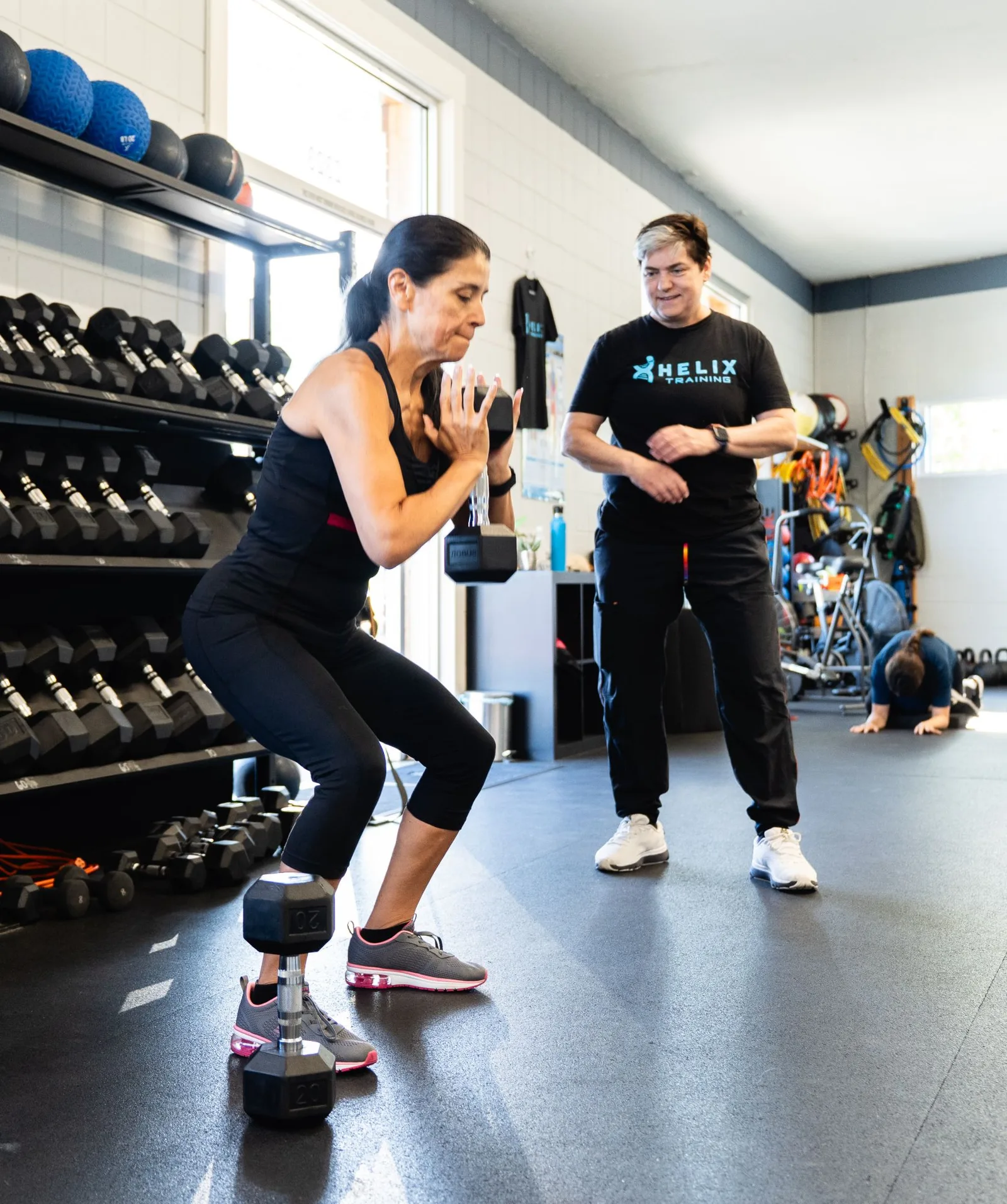
Mostly, no. Women get stronger the same way men do: lift something challenging, add a little more over time, rest, and repeat. That’s the headline from the National Strength and Conditioning Association (NSCA), which published a new two-part position statement on training female athletes in 2026. In plain words, the NSCA says “the basic principles of strength and conditioning remain relevant for all humans.”
When I coach women at Helix, the questions I hear aren’t really about sets and reps. The number one worry is “Will I get hurt?” My answer: the risk of getting hurt by not strength training is much higher than the risk of getting hurt by strength training. (I wrote a whole post on that: Is Strength Training Safe After 50?) After that come “Will I get bulky?”, “Should I back off during my period?”, and “Is it too late now that I’m through menopause?” The new NSCA papers speak to all three, so let’s walk through them.
One honest note first. These statements were written about female athletes, meaning women who train about three times a week to compete in a sport. That may not sound like you, but I believe there is an athlete in all of us. At Helix, we strength train to be athletic in life. We’re all competing against the clock to live long, quality lives. In my judgment, the big principles carry over just fine to anyone who lifts.
Will lifting weights make me bulky?
This is a worry I hear a lot, and here’s what I tell people: to get bulky, you would have to lift significant weight several times a week, for a long time, on purpose. It doesn’t sneak up on you after a few goblet squats.
The research backs that up. The NSCA notes that men’s bodies show a rise in hormones like testosterone after a hard lifting session, while women show “little to no” rise in testosterone. Over the long run, the statement says, men end up with more total muscle size and strength, mostly because their muscle fibers are larger. The gains women do see come from training with real load, generally above 60% of the most you can lift once.
So what does happen when women lift? They get much stronger. A 2020 review of 24 studies on women and strength training found large improvements in both upper and lower body strength. How often people trained and how much total work they did made the biggest difference. The muscle growth effect was medium-sized.
In other words, you get the strength you need to flip the trash can onto the curb, carry the groceries in one trip, and hike up Marys Peak without stopping every switchback. Bulky is not a side effect you trip into.
Should I train differently during my period?
For most women, no. This one surprises people, because “cycle syncing” is all over social media.
The NSCA looked at the best available research on menstrual cycle phase and strength. It found the phase of your cycle has only “a trivial impact” on performance for most women, and there is “not sufficient evidence” to change a lifting program around it. A separate 2023 umbrella review (a review of other reviews) agreed. It concluded it is “premature” to say normal hormone shifts make a real difference to strength or muscle growth from training.
Here’s the part I really like, though. The NSCA also says more than 65% of female athletes have cycle-related symptoms, like cramps, poor sleep, or feeling wiped out. And it says those symptoms should be tracked and taken seriously.
So my rule of thumb is this: train by how you feel, not by the calendar. If day one has you curled up with a heating pad, we lighten the load or swap the movement. If you feel great, lift. Neither choice is wrong. And if your periods are very painful, irregular, or have stopped (and you’re not pregnant or in menopause), that’s a conversation for your doctor, not your coach.
Is it too late to start lifting after menopause?
No. If anything, this is when lifting matters most.
The NSCA says muscle and strength start to slowly decline around age 30 without training, and peak bone density is usually reached by 25 to 30. Then, in menopause, estrogen drops. Estrogen helps build bone and supports muscle, so the drop raises the risk of osteoporosis (bones that are thinner and easier to break). It can also nudge up heart disease risk.
Here’s what the NSCA recommends: resistance training of “sufficient volume and intensity to increase and maintain muscle mass, including some heavy-load phases.” It also says older women “should not need to make significant alterations” to their training just because of menopause. You keep training. You adjust for the person, not the birthday.
That matches what I see in Strength+, our over-50 class. Women in their 50s, 60s, and 70s squat, deadlift, and carry heavy things, with a coach scaling every rep. If you already have osteoporosis, the NSCA says some movements may need to change (for example, limiting a lot of forward rounding of the spine). Please talk to your doctor or a PT first so we know what you’re working with. For more on getting started later in life, read Is Strength Training Safe After 50?.
What about knees and the pelvic floor?
Two topics in the NSCA paper are worth knowing about even if you never play a sport.
Knees. The knee is my favorite joint, so of course I read this part twice. Female athletes are 4 to 6 times more likely than male athletes to tear their ACL, one of the main ligaments inside the knee. The encouraging part: programs that combine strength, jumping and landing practice, agility, balance, and mobility can cut ACL injury risk by about 50%. The NSCA suggests focusing on the hips, knees, and ankles, training one leg at a time, and practicing how to land softly. Those are things we work on in our classes anyway. Split squats, step-ups, and heel raises earn their place.
Pelvic floor. Leaking a little when you jump, cough, or lift is common. The NSCA reports that about 1 in 3 female athletes (36%) deal with it. Common doesn’t mean you have to live with it. The paper notes that 56% to 70% of women recover with the right education and pelvic floor strengthening. If this is you, a pelvic health PT is a great person to see, and you are still welcome on the gym floor while you work on it.
So what actually changes for women?
Less than you’d think. Here’s the short version I’d give a new member:
- Same basics. Challenging weight, gradual progress, good rest. The NSCA says women’s expectations for gains in strength and power “should not differ” from men’s.
- Program for the person. Your history, goals, and how you’re recovering matter more than your sex.
- Don’t skip upper body. The NSCA notes upper body strength is often lower in women, even accounting for size. So we give pushing and pulling real attention. Lifting a grandkid or a carry-on into the overhead bin is an upper body job.
- Listen to symptoms. Track how you feel across your cycle, through menopause, and after injuries, then adjust the day, not the whole plan.
The NSCA also makes a point I really appreciate: a lot of what has been blamed on women’s biology is really about access. Women have often had less coaching, less equipment, and less time in the weight room. It isn’t a lack of ability. That’s a big part of why I love running a gym where every body gets good coaching from day one.
Your next step
If you’ve been wondering whether lifting is “for you,” it is. Come try a free class in Corvallis, meet a coach, and we’ll start right where you are.
This article is general education, not medical advice. If you have pain, an injury, a medical condition, or you’re pregnant or postpartum, talk with your doctor or physical therapist about what’s right for you.
References
- Dabbs NC, et al. (National Strength and Conditioning Association), 2026. Position statement on strength and conditioning of female athletes. Part I: Lifespan, injury, and health considerations. Journal of Strength and Conditioning Research. link
- Dabbs NC, et al. (National Strength and Conditioning Association), 2026. Position statement on strength and conditioning of female athletes. Part II: Training adaptations and program design. Journal of Strength and Conditioning Research. link
- Hagstrom AD, et al., 2020. The effect of resistance training in women on dynamic strength and muscular hypertrophy: a systematic review with meta-analysis. Sports Medicine. link
- Colenso-Semple LM, et al., 2023. Current evidence shows no influence of women’s menstrual cycle phase on acute strength performance or adaptations to resistance exercise training. Frontiers in Sports and Active Living. link